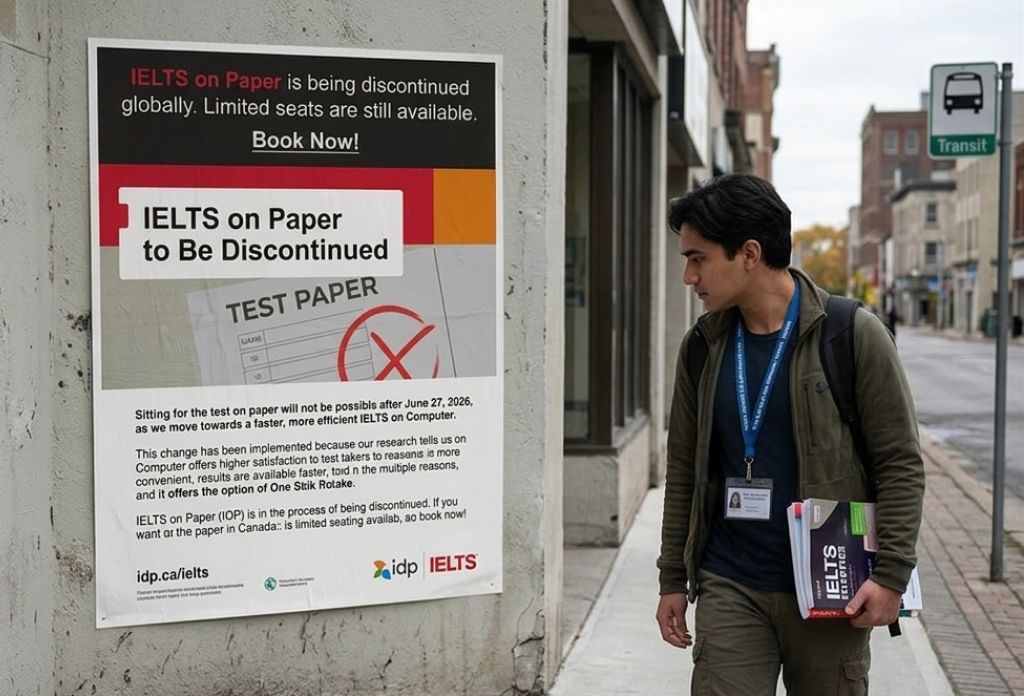
IDP IELTS Canada says IELTS on Paper will no longer be available after June 27, 2026. Here’s what this means for test takers and why digital practice matters more than ever.
When a major test format starts fading out, smart students do not panic. They adapt.
That is exactly what is happening now with IELTS on Paper. IDP IELTS Canada has announced that IELTS on Paper is being discontinued, with June 27, 2026 listed as the final date to sit the paper-based test in Canada. In IDP’s own words, “Sitting for the test on paper will not be possible after June 27, 2026”.
For us at Winelts, this is not surprising. It confirms a shift that serious IELTS learners have already been feeling for a while: preparation is no longer just about knowing the question types. It is also about becoming comfortable with the real testing environment you are most likely to face.
The headline change: paper is ending, but IELTS itself is not
Let’s make the most important point clear first.
According to IDP IELTS Canada’s announcement, the paper-based option in Canada ends after June 27, 2026. But this does not mean the exam content, scoring system, or difficulty level is changing.
IDP makes this point very clearly: “There are no changes if you book your IELTS on Computer.” It also states that “The content, difficulty, and scoring (0-9 band scale) for both test formats remain identical.” The Speaking test also remains a face-to-face interview with an examiner regardless of the format.
So this is not a change in what IELTS measures. It is a change in how more candidates will experience the test.
That distinction matters.
Why this matters more than many students think?
A lot of students still say things like:
- “I just prefer writing on paper.”
- “I can manage the format later.”
- “As long as I know English, the device does not matter.”
In practice, that mindset can cost performance.
Even when the scoring criteria stay the same, the test-taking experience changes your rhythm. Reading on a screen, navigating questions digitally, typing under time pressure, and keeping focus without the comfort of paper all affect real test behavior.
That is why this is bigger than a simple operational update. It reflects a broader reality: IELTS prep is no longer only language prep. It is also format adaptation.
And that is one of the reasons digital-first preparation platforms are becoming more relevant, not less.
A useful detail many students may miss
One detail in the official IDP update stands out.
Although full IELTS on Paper is being discontinued, IDP says it is introducing a “Writing on Paper” option. As the article explains, “We are aware that many test takers like handwriting answers” and this new option “will allow test takers to personalize their test experience.” This means test takers who prefer handwriting will still have a way to write their answers to the Writing component on paper if they choose.
That tells us something important about where the test is going.
Digital delivery is clearly becoming the default, but test providers still recognize that some learners have strong preferences around handwriting. So the future does not look like “old versus new”, It looks more like digital-first, with selective flexibility where it helps candidates.
What Winelts saw early
At Winelts, we have been building around this direction from the start.
We are not treating IELTS practice as a static library of questions. We see it as a system that has to stay aligned with the real exam world as that world changes. That includes:
- how candidates interact with tasks,
- how delivery formats influence performance,
- how feedback should be given,
- and how practice should evolve when official formats or preferences shift.
This is one reason we are providing an app-based practice experience rather than treating preparation like a PDF archive from years ago.
Because if the exam ecosystem is moving toward faster, more digital, more adaptive delivery, then preparation has to move too.
We noticed this paradigm shift earlier, and we continue to adapt as formats, delivery methods, and test-taker expectations evolve.
What students should do now
1. Stop assuming paper will remain your safe option
If you were postponing digital adaptation because you thought paper would always be available, that assumption is no longer reliable. In Canada, the final IELTS on Paper date announced by IDP is June 27, 2026.
2. Practice in the environment you are most likely to face
If your actual test will probably be computer-based, your preparation should reflect that. Familiarity reduces friction. Friction wastes time. And in IELTS, wasted time often becomes wasted score.
3. Build both language skill and interface confidence
Good vocabulary and grammar still matter. So do timing, navigation, typing comfort, visual scanning, and digital stamina.
4. Follow official updates, not old assumptions
IDP also says, “We will continue to publish updates related to IELTS over the coming months,” which means candidates should keep an eye on official IELTS news and article updates.
Final thought
IELTS on Paper ending in Canada is not the end of opportunity for candidates. It is a signal.
- A signal that test-taking is becoming more digital.
- A signal that preparation has to become more realistic.
- And a signal that learners who adapt early will have an advantage.
At Winelts, we noticed this shift early, and we will keep adapting as the format evolves. That is part of the job when you build for real students with real score goals.
The exam world changes. Your prep should change with it.